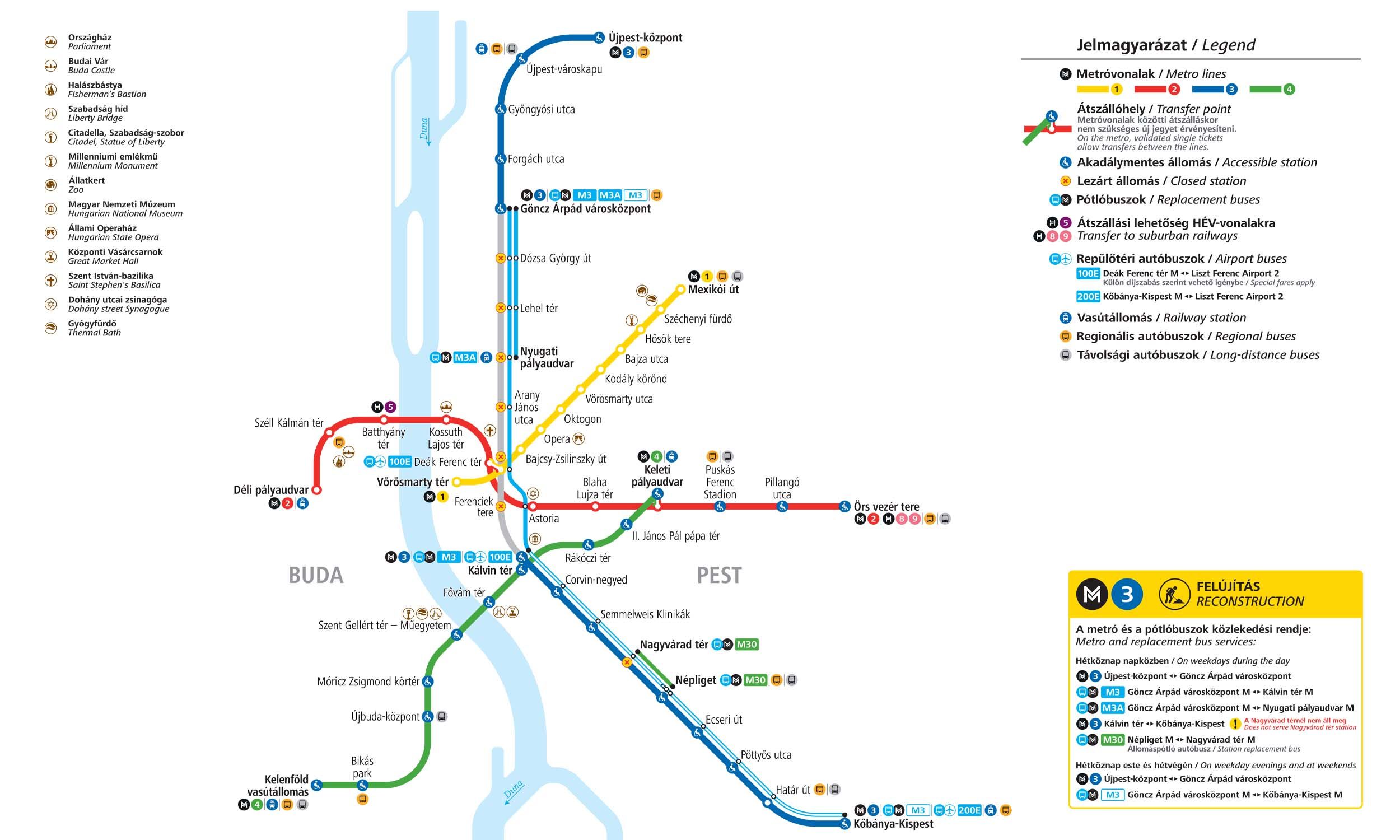
Budapest Metro
Budapest, Hungary
ActiveBudapest Metro Lines (4)
Budapest Metro Overview
The Budapest Metro is a rapid transit system in Budapest, the capital of Hungary. It is the oldest electrified underground railway system in the world, and the second oldest underground railway system with multiple stations after the originally steam-powered London Underground. Inaugurated in 1896, the Budapest Metro is not only one of the oldest metro systems in the world, but also a testament to the city's commitment to modern urban life. With four lines in the city (M1, M2, M3 and M4), the metro network provides extensive coverage, connecting iconic sites, cultural centers and residential neighbourhoods. Renowned for its architectural diversity, the Budapest Metro stations display a mix of historical and contemporary designs, reflecting the rich tapestry of Hungarian culture.
Budapest Metro Key Facts
- The Budapest Metro, officially known as the Budapest Metro, made its debut in 1896 as the world's second oldest underground railway.
- Budapest's metro system consists of four lines – M1 (yellow), M2 (red), M3 (blue), and M4 (green) – which provide extensive coverage throughout the city.
- Line M1, also known as the Millennium Underground, is not only the oldest line in Budapest, but is also recognized as a UNESCO World Heritage Site for its historical significance.
- The metro stations in Budapest exhibit a diverse range of architectural styles, some of which retain their historical charm and others adopting modern designs.
- The construction of Line M3 during the Soviet era left a notable mark on the metro system, with the stations being characterized by grandeur and monumental design.
- Many sections of the Budapest Metro are constructed deep underground, using a tunneling method to navigate beneath the city's surface.
- The metro integrates seamlessly with other modes of public transport, including buses, trams and suburban railway services.
- Many metro stations have art installations, sculptures and murals, which add a cultural dimension to the commuting experience.
- Budapest's metro system serves a large number of daily commuters, playing an important role in the city's overall transportation efficiency.
- Budapest continues to invest in the development and modernization of its metro system, with plans for expansion and upgrades to meet the city's growing needs.
Budapest Metro Info
- Operator Capital City of Budapest
- Operation Started 1896
- Total Lines 4
Budapest Metro Map