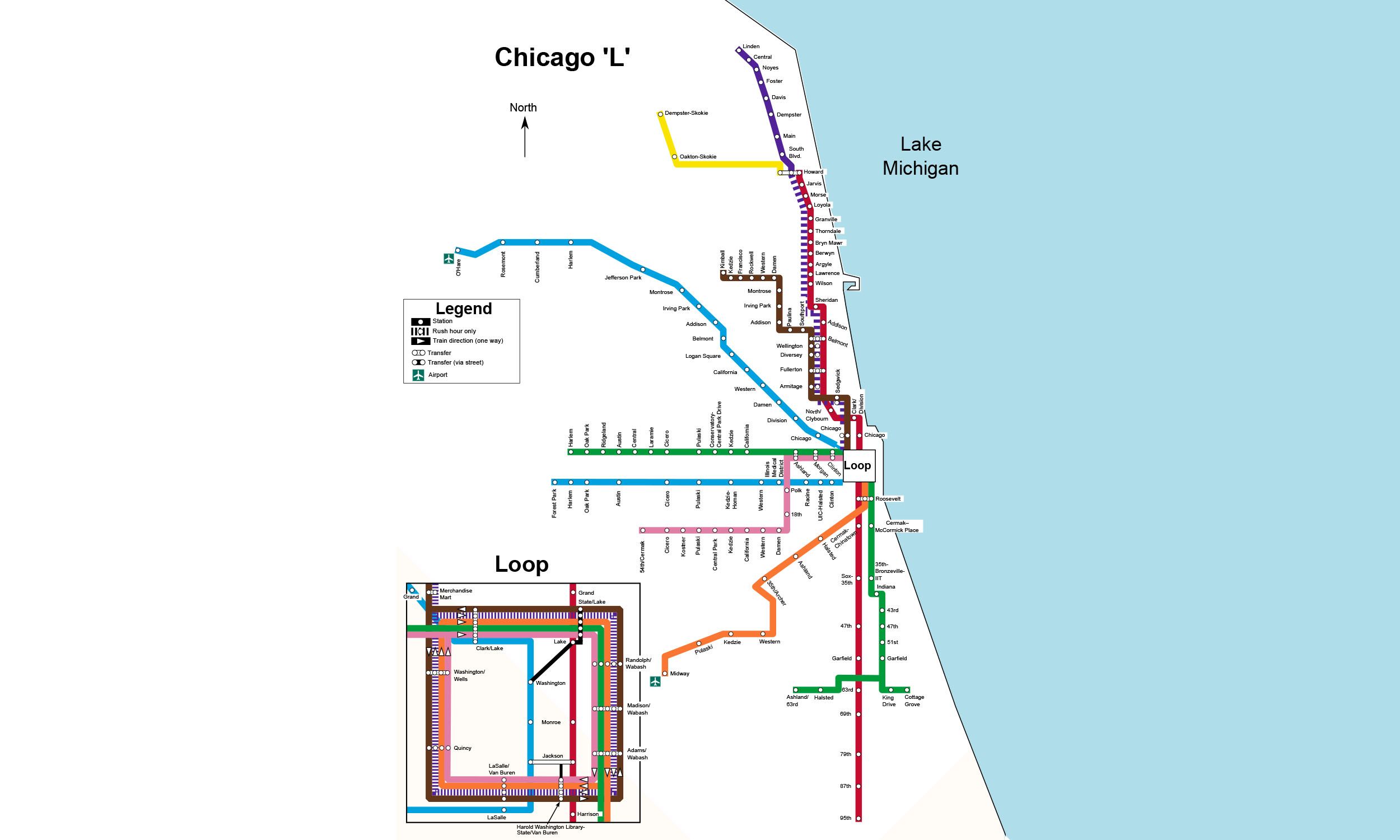
Chicago \L\
Chicago, United States
ActiveChicago \L\ Lines (9)
Chicago \L\ Overview
The Chicago L is a rapid transit system serving the city of Chicago and some surrounding suburbs in the U.S. state of Illinois. The L provides 24-hour service on the Red and Blue lines, making Chicago, New York City, and Copenhagen the only three cities in the world to offer 24-hour train service on some lines in their respective city limits. . The oldest sections of the Chicago L began operating in 1892, making it the second oldest rapid transit system in the US, after New York City's elevated lines. The L has been credited with promoting Chicago's dense downtown development, one of the city's distinguishing characteristics. It consists of eight rapid transit lines in a spoke-hub distribution paradigm focusing on transit towards the loop. The L gets its name because large parts of the system run on elevated tracks. As a testament to its historic importance, the Chicago L continues to evolve, meeting the city's dynamic needs and maintaining its position as a vital artery of urban transportation.
Chicago \L\ Key Facts
- The Chicago L (short for elevated) began operation on June 6, 1892, making it one of the oldest rapid transit systems in the world.
- The L has a hub-and-spoke system in which the Loop, lines radiating from Chicago's central business district, connect various neighborhoods and surrounding suburbs.
- The L consists of eight color-coded lines, including the Red Line, Blue Line, Brown Line, Green Line, Orange Line, Pink Line, Purple Line, and Yellow Line, each serving different routes.
- While portions of the L run on elevated tracks above city streets, other sections operate underground in subway tunnels, creating a diverse transit experience.
- The L has played a significant role in shaping Chicago's urban development and has been featured in numerous films, TV shows, and works of literature, contributing to its cultural significance.
- The Loop, a winding section in Downtown Chicago, serves as a major transit hub where several L lines intersect and connect, allowing easy transfers for passengers.
- Many L stations feature public art installations, showcasing a diverse range of artistic expressions and enhancing the overall aesthetic experience for passengers.
- The iconic and easy-to-read L map, designed by Harry Weiss, has become a model for transit maps around the world, known for its simplicity and clarity.
- The L integrates seamlessly with other modes of public transportation, including buses and Metra commuter rail, providing a comprehensive transit network for the Chicago metropolitan area.
- Some L lines, such as the Red and Blue lines, offer 24-hour service, providing around-the-clock access for residents and visitors in a city known for its vibrant nightlife.
Chicago \L\ Map