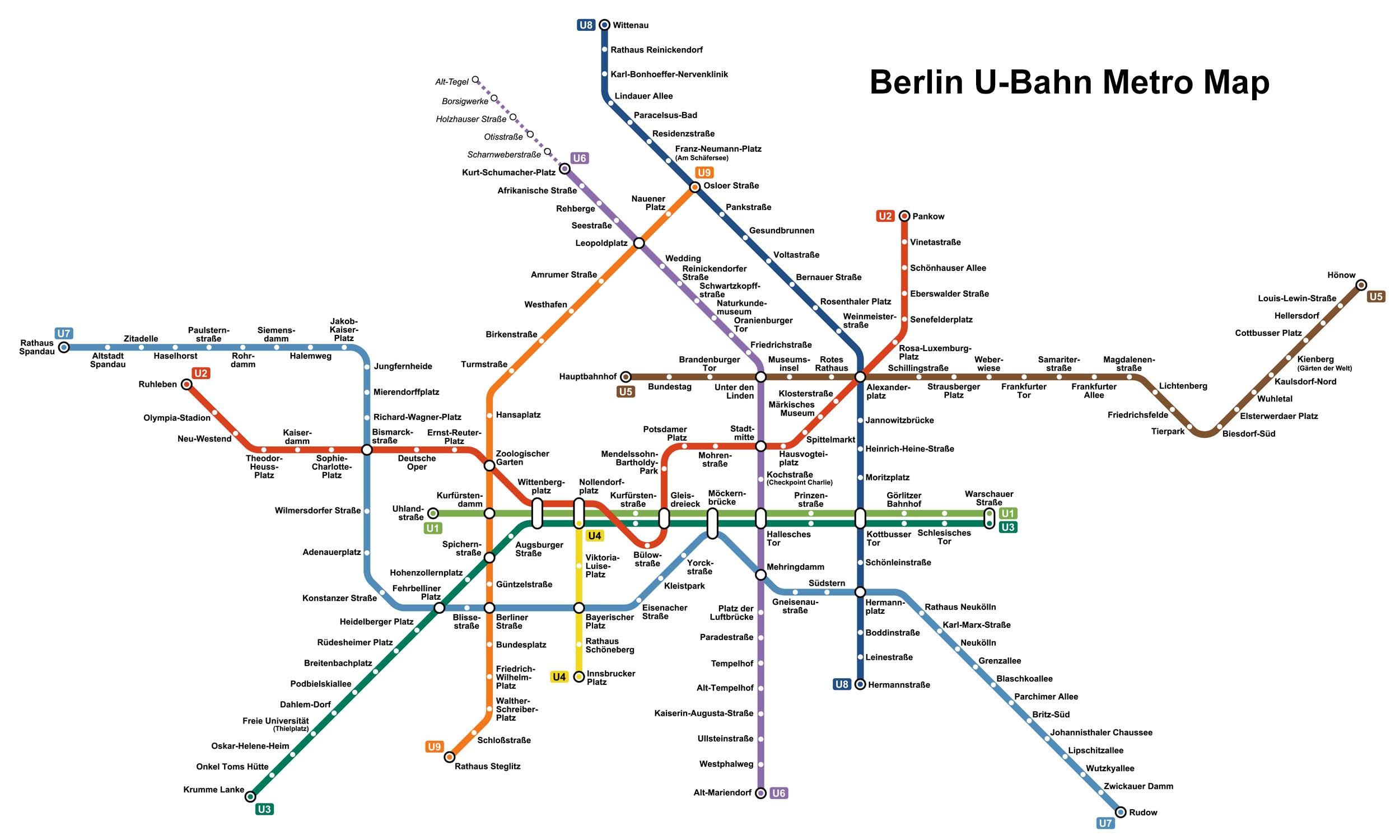
Berlin U-Bahn Metro
Berlin, Germany
ActiveBerlin U-Bahn Metro Lines (9)
Berlin U-Bahn Metro Overview
The Berlin U-Bahn is a rapid transit system in Berlin, Germany's capital and largest city, and a major part of the city's public transportation system. Inaugurated in 1902, the Berlin U-Bahn has played an important role in shaping the city's identity and meeting the growing transportation needs of its residents. The U-Bahn serves 175 stations spread over nine lines, with a total track length of 155.64 kilometres, about 80% of which is underground. With its distinctive blue and white signage, the U-Bahn network consists of 10 lines, denoted as U1 to U9 and U55, which run through diverse neighborhoods of Berlin and connect major destinations. As an integral part of Berlin's comprehensive public transport system, the U-Bahn seamlessly integrates with the S-Bahn, buses and trams, creating a cohesive and well-connected transit network.
Berlin U-Bahn Metro Key Facts
- The Berlin U-Bahn, officially known as the Berliner U-Bahn, began operations in 1902, making it one of the oldest metro systems in the world.
- The U-Bahn network in Berlin is extensive, with 10 lines (U1 to U9 and U55) covering different parts of the city, providing mass urban transit.
- Many U-Bahn stations display iconic design elements, with notable examples such as the WittenbergPlatz station, designed by Alfred Grenander, which contributes to the architectural character of the city.
- The U-Bahn seamlessly integrates with the S-Bahn (suburban railway) and other forms of public transport, creating a well-connected transit network.
- Parts of the U-Bahn are constructed deep underground, using tunneling technology that was revolutionary in the early 20th century.
- The Berlin U-Bahn played an important role in the city's history, serving as an important means of transportation during various periods, including the division of East and West Berlin.
- The U-Bahn employs a dual-voltage system (750 V DC and 800 V DC), allowing flexibility and compatibility with different parts of the network.
- Many U-Bahn stations feature artistic installations and designs, which add a cultural and aesthetic dimension to the commute experience.
- Known for its efficiency and punctuality, the U-Bahn is a reliable mode of transport, providing frequent and timely services to passengers.
- The Berlin U-Bahn serves a large number of daily passengers, reflecting its importance in the daily lives of Berliners and visitors.
Berlin U-Bahn Metro Info
- Operator Berliner Verkehrsbetriebe (BVG)
- Operation Started 1902
- Total Lines 9
Berlin U-Bahn Metro Map